Our executive committee approved a list of candidates and, in keeping with party tradition of "it's the case, not the face", decided that the order on the ballot paper would be decided randomly.
The criterion for being a Socialist Party candidate is demonstrably understanding the party's case. The EC had to choose from a list of people who have managed to prove that they can do that. All our candidates are equals within the party, and the listing reflects no more than the order their names came out of the hat.
They are:
Dannny LambertTristan MillerJanet CarterBill MartinAdam BuickSimon WigleyFrederick AllenPatricia Deutz
You can come hear that case at the following meetings:
Sunday 17 May, 6pm
YOUR CHANCE TO VOTE FOR WORLD SOCIALISM
Speakers: Danny Lambert, Tristan Miller
Socialist Party Head Office, 52 Clapham High St, London SW4 (nearest tube: Clapham North).
And:
Every Sunday between now and election time Hyde Park Speakers' Corner, Danny Lambert, Bill Martin & Adam Buick will be speaking from around 10 in the morning till mid afternoon.

Socialist Party Election Blog : The blog by Socialists involved in Socialist Party campaigning in London Elections. For the main party website click Here
Showing posts with label SPGB. Show all posts
Showing posts with label SPGB. Show all posts
Tuesday, April 21, 2009


Wednesday, April 30, 2008
The last leaflet
The last of the nearly 20,000 leaflets distributed in the constituency was put through a letter box in Woodsmansterne Road, SW16 this afternoon. This is a long road at the southernmost point of the constituency. It's actually in Streatham (part of Lambeth), but continue too far along it and you end up in Croydon, take a wrong turning and you end up in Merton (one Labour canvasser had done the opposite as we saw a Labour leaflet supporting their candidate in Merton).
This is a reminder that "Lambeth and Southwark" includes areas which are not traditionally associated with these two historic places. Another is a letter we received from a Miss Wright of Pymers Mead, West Dulwich, SE21. She wrote:
"Dear Sir/Madam,
I am returning the leaflet you put through my letterbox as I don't you putting anymore of your leaflets through my letterbox again".
We don't know if she wrote similar letters to the other parties about the leaflets they put through her letterbox, but they seem a polite lot down in Dulwich (she actually put a stamp on the letter, if she'd read the leaflet properly she could have sent it to our freepost address and saved herself 27p). Normally, people who don't like our leaflets tear them up in front of us and tell us they're voting for the BNP.
But the most common reaction we got on the doorsteps was "it doesn't make any difference anyway who gets in". Which corresponds with our analysis and shows that workers are not stupid: a lot of them do realise what's going on. Only they don't think they can do anything about it, so they just abstain and don't bother to vote at sll. It is highly likely that, tomorrow, the abstainers will be the absolute majority.
So, why if it makes no difference who gets in, were we standing? First, to use a period of heightened interest in politics to put across our case for a society of common ownership, democratic control, production for use, and distribution on the basis of "from each according to their ability, to each according to their needs". And, second, because if workers use their votes intelligently in their own interest they could change things, they could use the vote to help get rid of the profit system and bring in socialism.
It's voting for leaders to try to run the profit system in the interests of the majority that makes no difference, not voting in itself. That's why, where there's no socialist candidate, instead of abstaining we go to the polling station and vote, even if it's only a write-in vote. A way of keeping a potential weapon sharpened for the time when a majority are ready to use it in their own interest. Where there is a socialist candidate standing, we vote for them.
And there is a socialist candidate in Lambeth and Southwark.
This is a reminder that "Lambeth and Southwark" includes areas which are not traditionally associated with these two historic places. Another is a letter we received from a Miss Wright of Pymers Mead, West Dulwich, SE21. She wrote:
"Dear Sir/Madam,
I am returning the leaflet you put through my letterbox as I don't you putting anymore of your leaflets through my letterbox again".
We don't know if she wrote similar letters to the other parties about the leaflets they put through her letterbox, but they seem a polite lot down in Dulwich (she actually put a stamp on the letter, if she'd read the leaflet properly she could have sent it to our freepost address and saved herself 27p). Normally, people who don't like our leaflets tear them up in front of us and tell us they're voting for the BNP.
But the most common reaction we got on the doorsteps was "it doesn't make any difference anyway who gets in". Which corresponds with our analysis and shows that workers are not stupid: a lot of them do realise what's going on. Only they don't think they can do anything about it, so they just abstain and don't bother to vote at sll. It is highly likely that, tomorrow, the abstainers will be the absolute majority.
So, why if it makes no difference who gets in, were we standing? First, to use a period of heightened interest in politics to put across our case for a society of common ownership, democratic control, production for use, and distribution on the basis of "from each according to their ability, to each according to their needs". And, second, because if workers use their votes intelligently in their own interest they could change things, they could use the vote to help get rid of the profit system and bring in socialism.
It's voting for leaders to try to run the profit system in the interests of the majority that makes no difference, not voting in itself. That's why, where there's no socialist candidate, instead of abstaining we go to the polling station and vote, even if it's only a write-in vote. A way of keeping a potential weapon sharpened for the time when a majority are ready to use it in their own interest. Where there is a socialist candidate standing, we vote for them.
And there is a socialist candidate in Lambeth and Southwark.
Saturday, April 26, 2008
The Big Issue in Southwark
This week's Southwark News (out on Thursday) has an 8-page supplement on the mayor and assembly elections. The same set of questions was put to all the candidates. Here they are together with the replies of "Daniel Lambert - The Socialist Party".
What can you do to alleviate the rise of gun and gang crime amongst the youth in Southwark?
Condemnation of gun crime is all very well but you have to go to the root of the problem, which is that young people are alienated. To change that we need to change the nature of society we live in.
How hard will you be fighting for the Cross River Tram and what more can be done to improve connections within the borough?
We are a single issue party and try to put information out to convince people of the merits of socialism. London is a business venture, and is a centre for processing information, with this workers have to be got here there and everywhere, in and around Southwark and London.
Are you aware of any regeneration schemes in the area? How effectively will they solve the issues in that area?
No I am not. We are so busy taking care of business we just don’t take care of ourselves, get rid of the profit system and we will have more time to take care of ourselves.
What is the big Southwark issue at this time?
Capitalism, because without this we the human species have the potential at our fingertips to create a really good human life.
What one thing can you promise to bring to Southwark if you are voted in on May 1?
Well I am not going to get voted in. We want to put our proposition to have a society where there is no money or trade, and no market. The thing we have to get across is all the time that capitalism is about working people getting screwed.
What can you do to alleviate the rise of gun and gang crime amongst the youth in Southwark?
Condemnation of gun crime is all very well but you have to go to the root of the problem, which is that young people are alienated. To change that we need to change the nature of society we live in.
How hard will you be fighting for the Cross River Tram and what more can be done to improve connections within the borough?
We are a single issue party and try to put information out to convince people of the merits of socialism. London is a business venture, and is a centre for processing information, with this workers have to be got here there and everywhere, in and around Southwark and London.
Are you aware of any regeneration schemes in the area? How effectively will they solve the issues in that area?
No I am not. We are so busy taking care of business we just don’t take care of ourselves, get rid of the profit system and we will have more time to take care of ourselves.
What is the big Southwark issue at this time?
Capitalism, because without this we the human species have the potential at our fingertips to create a really good human life.
What one thing can you promise to bring to Southwark if you are voted in on May 1?
Well I am not going to get voted in. We want to put our proposition to have a society where there is no money or trade, and no market. The thing we have to get across is all the time that capitalism is about working people getting screwed.
Friday, April 25, 2008
What else do we want?
Some more from Socialism as a Practical Alternative - this time on the practical organisation of a moneyless economy, and how we see production occuring without some sort of central planning or dictatorial centre:
Socialism will remove every factor of value, cost and price involved in production and therefore there will be no use for money. As marketable commodities under capitalism, bread, shoes, housing and, indeed, labour power are in value relationships to each other which are expressed through prices. In socialism these value relationships will not exist. Capitalism is an exchange economy which begins with an exchange of workers’ labour power for wages and ends with the realisation of profit through the exchange of goods for money in the market. Socialism will relate productive activity directly to needs. Production for use will begin with co-operation between producers and end with the direct supply of goods to the members of the community for whose needs they have been produced. Only socialism can be a practical system for the production and distribution ofgoods directly for consumption.
[...]
In practical terms, needs would arise in local communities expressed as required quantities of machinery, equipment, building materials, and the whole range of foods and consumption goods. These grammes, kilos, tonnes, litres, cubic metres of required materials and goods would then be communicated throughout the distributive and productive network.
The monitoring and communications of needs, expressed as a demand on stocks or required production, would be clear and readily known. The supply of some needs would take place within the local community, as for example with food production for local consumption, local building, maintenance and the running of local services. Other needs would be communicated to regional production units, For example, local building might require glass for housing which was produced regionally. A local need for glass would then be communicated through the distributive network and would pass to the regional glassworks. In its turn, the glassworks would have its own suppliers of the materials used in glass production, so the required quantities of these would then be passed on. This would be the sequence of communications through which a local need for glass would be transmitted to every unit involved in glass production within a region. Other needs would be communicated throughout the structure of production up to a world scale. Local food production might require tractors. Regional manufacture would produce and assemble the component parts of tractors for distribution to local communities. These would be required in a definite number and therefore a definite number of required component parts would also be known. Again, the tractor-producing plant would communicate these requirements to its own suppliers. Eventually this would extend to world production units which would be mining and processing the raw materials, such as metals, required for tractor production.
This could be a self-adjusting system of production for use.
Thursday, April 24, 2008
What do we want?
A common complaint is that we spend a lot of time knocking capitalism and rival candidates - all well and good, people say, capitalism is terrible, but what are you saying should be done about it?
Thus, having spent the first few weeks of capmaigning concentrating on the failings of other parties, I'm going to spend the rest publishing excerpts from our literature on why we think socialism is the solution.
To begin with, and this is relevent to the comments on yesterday's post, an excerpt from Socialism as a Practical Alternative, on democracy.
Thus, having spent the first few weeks of capmaigning concentrating on the failings of other parties, I'm going to spend the rest publishing excerpts from our literature on why we think socialism is the solution.
To begin with, and this is relevent to the comments on yesterday's post, an excerpt from Socialism as a Practical Alternative, on democracy.
Under capitalism, governments, through their control of the state machinery, lay down the law and impose it on the whole of society, if necessary by force.[...] With socialism this dominant feature of the structure will be immediately abolished. The power of the state, which operates from the concentration of centralized power in the hands of governments, will be replaced by a fully democratic system through which decisions will flow from the broadest possible social base to represent the views of the whole community.
A democratic system of decision-making would require that the basic unit of social organisation would be the local community which could elect is delegates to a local council which could be given the responsibility for local administration. If, for example, local communities in socialism began by operating from the basis of the existing structure of district councils in England, this would give 332 local communities. This would be a democratic development of the existing procedures for electing local councils which could become the basic means for dealing with day-to-day local issues. Then, regional councils could provide organisation through which decisions affecting wider populations could be made at the regional level. Similarly, global decisions could be made by delegates elected to a world council.
Friday, April 18, 2008
What we said
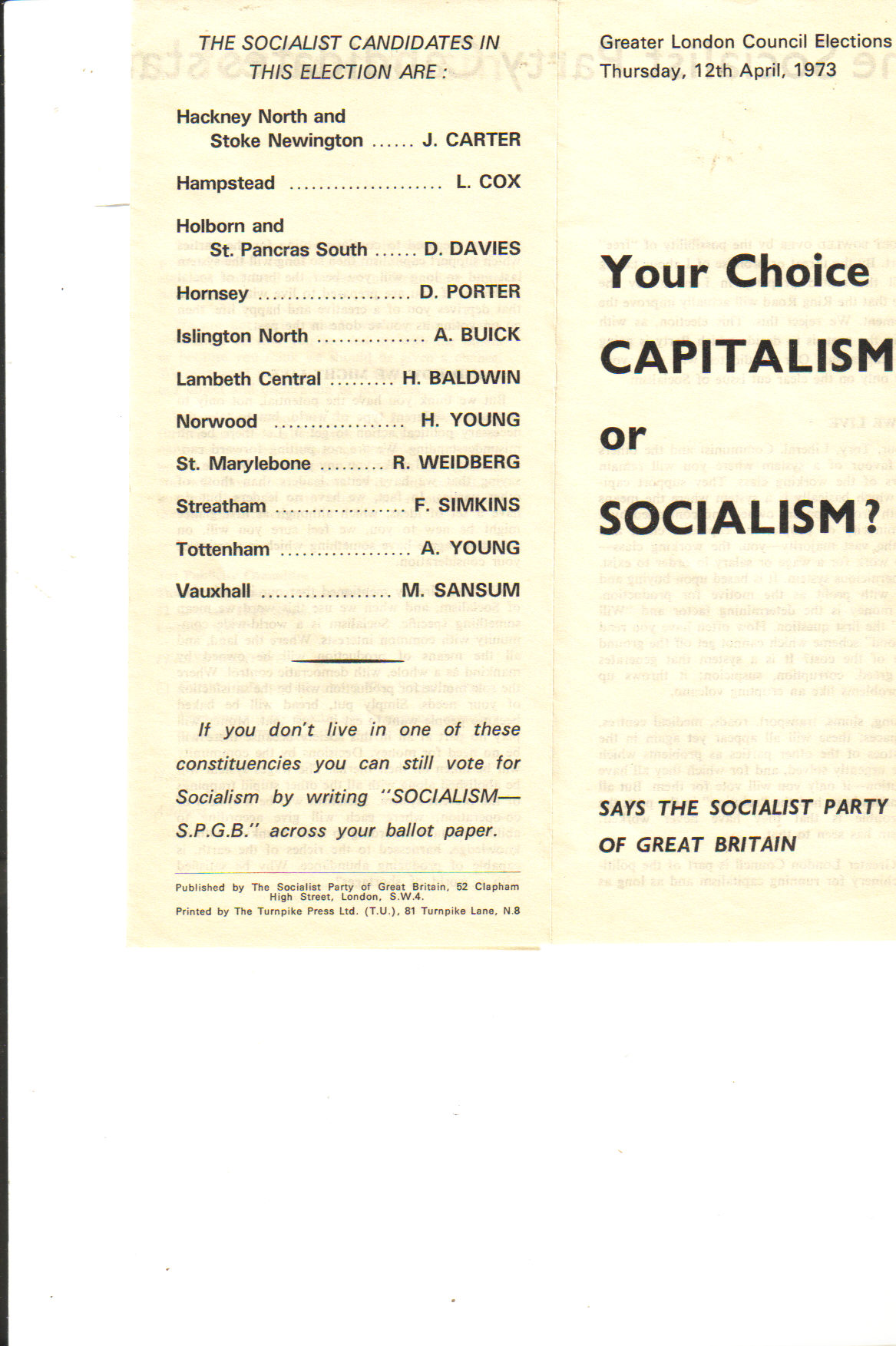
For those curious about what we said on the inside pages of the manifesto we put out for the 1973 GLC elections when we stood in Clapham, Streatham, Norwood and the other places and which we showed here a few days ago (see here) Not much different from what we say today. That's because the issue is still the same: Capitalism or Socialism? Not the different ways of running (or, rather, trying to run) capitalism offered by the other parties.
YOUR CHOICE CAPITALISM OR SOCIALISM?
Don't get bowled over by the possibility of "free" transport. By the threat or promise of Labour taking over all the rented property in London. By the promise that the Ring Road will actually improve the environment. We reject this. This election, as with others in the past, is to decide which Party is going to run capitalism. Our candidates will seek your support only on the clear cut issue of Socialism.
HOW WE LIVE
Labour, Tory, Liberal, Communist and the others are in favour of a system where you will remain members of the working class. They support capitalism, which basically is a system where the means of wealth production are owned and controlled by a small minority of people, the capitalist class, and where the vast majority—you, the working class— have to work for a wage or salary in order to exist. It is a pernicious system. It is based upon buying and selling, with profit as the motive for production. Where money is the determining factor and "Will it pay?" the first question. How often have you read of a "good" scheme which cannot get off the ground because of the cost? It is a system that generates waste, greed, corruption, suspicion; it throws up social problems like an erupting volcano.
Housing, slums, transport, roads, medical centres, open spaces; these will all appear yet again in the manifestoes of the other parties as problems which must be urgently solved, and for which they all have the solution—if only you will vote for them. But all these parties have had the "solution" in the past; the only trouble is that they have never worked; capitalism has seen to that.
The Greater London Council is part of the political machinery for running capitalism and as long as you are prepared to continue voting for the parties which support capitalism then so long will the system last and so long will you bear the brunt of social problems. If you are prepared to live with a system that deprives you of a creative and happy life, then go on voting as you've done in the past.
. . . AND HOW WE MIGHT LIVE
But we think you have the potential, not only to envisage a different type of world, but to take the necessary political action to get it. Let there be no misunderstanding. We are not putting forward candidates who will make you any promises. We are not saying that we have better leaders than those of other parties. In fact, we have no leaders, but do have a set of ideas, which although at first glance might be new to you, we feel sure you will, on reflection, agree have something which is worthy of your consideration.
We have already mentioned that our issue is that of Socialism, and when we use this word we mean something specific. Socialism is a world-wide community with common interests. Where the land, and all the means of production will be owned by mankind as a whole, with democratic control. Where the sole motive for production will be the satisfaction of your needs. Simply put, bread will be baked because people want to eat it—just that. Money will play no part at all in this society because there will be no need for money. Decisions by the community will be taken on their merits. The wages system will be abolished along with all the other stupid trappings of the present system. Socialism will be a system of co-operation; where each will give according to ability and take according to need. Mankind with its knowledge, harnessed to the riches of the earth, is capable of producing abundance. Why be satisfied with a world of shortages?
Socialism cannot be introduced by waving a magic political wand. It will be the outcome of understanding and hard work; your understanding, your hard work.
We are not asking you to vote for the Socialist candidates because you are fed up with the others or because you think we should be given a chance. We only want your vote if you agree with our case, our object and declaration of principles.
Take a momentous step for your future by making further enquiries about THE SOCIALIST PARTY OF GREAT BRITAIN; by reading our literature and making up your own mind whether at last in this election you will have nothing more to do with capitalism, but will throw in your weight and resources with the Socialist movement.
YOUR CHOICE CAPITALISM OR SOCIALISM?
Don't get bowled over by the possibility of "free" transport. By the threat or promise of Labour taking over all the rented property in London. By the promise that the Ring Road will actually improve the environment. We reject this. This election, as with others in the past, is to decide which Party is going to run capitalism. Our candidates will seek your support only on the clear cut issue of Socialism.
HOW WE LIVE
Labour, Tory, Liberal, Communist and the others are in favour of a system where you will remain members of the working class. They support capitalism, which basically is a system where the means of wealth production are owned and controlled by a small minority of people, the capitalist class, and where the vast majority—you, the working class— have to work for a wage or salary in order to exist. It is a pernicious system. It is based upon buying and selling, with profit as the motive for production. Where money is the determining factor and "Will it pay?" the first question. How often have you read of a "good" scheme which cannot get off the ground because of the cost? It is a system that generates waste, greed, corruption, suspicion; it throws up social problems like an erupting volcano.
Housing, slums, transport, roads, medical centres, open spaces; these will all appear yet again in the manifestoes of the other parties as problems which must be urgently solved, and for which they all have the solution—if only you will vote for them. But all these parties have had the "solution" in the past; the only trouble is that they have never worked; capitalism has seen to that.
The Greater London Council is part of the political machinery for running capitalism and as long as you are prepared to continue voting for the parties which support capitalism then so long will the system last and so long will you bear the brunt of social problems. If you are prepared to live with a system that deprives you of a creative and happy life, then go on voting as you've done in the past.
. . . AND HOW WE MIGHT LIVE
But we think you have the potential, not only to envisage a different type of world, but to take the necessary political action to get it. Let there be no misunderstanding. We are not putting forward candidates who will make you any promises. We are not saying that we have better leaders than those of other parties. In fact, we have no leaders, but do have a set of ideas, which although at first glance might be new to you, we feel sure you will, on reflection, agree have something which is worthy of your consideration.
We have already mentioned that our issue is that of Socialism, and when we use this word we mean something specific. Socialism is a world-wide community with common interests. Where the land, and all the means of production will be owned by mankind as a whole, with democratic control. Where the sole motive for production will be the satisfaction of your needs. Simply put, bread will be baked because people want to eat it—just that. Money will play no part at all in this society because there will be no need for money. Decisions by the community will be taken on their merits. The wages system will be abolished along with all the other stupid trappings of the present system. Socialism will be a system of co-operation; where each will give according to ability and take according to need. Mankind with its knowledge, harnessed to the riches of the earth, is capable of producing abundance. Why be satisfied with a world of shortages?
Socialism cannot be introduced by waving a magic political wand. It will be the outcome of understanding and hard work; your understanding, your hard work.
We are not asking you to vote for the Socialist candidates because you are fed up with the others or because you think we should be given a chance. We only want your vote if you agree with our case, our object and declaration of principles.
Take a momentous step for your future by making further enquiries about THE SOCIALIST PARTY OF GREAT BRITAIN; by reading our literature and making up your own mind whether at last in this election you will have nothing more to do with capitalism, but will throw in your weight and resources with the Socialist movement.
Thursday, April 17, 2008
Vote early
Just on the off chance, this is our only means of chasing up, but word on the street is that folks can start casting their postal ballots soon - so if you are going to postal vote in Lambeth & Southwark and (and only if) you agree with the sorts of things set out here - then vote for Danny Lambert The Socialist Party candidate.
And, hell, let us know you have in the comments boxes below, you know you can do so anonymously - or email and let us know - your early support can carry our campaign forward.
And if you don't live in Lambeth & Southwark, and you're going to cast a postal write-in vote, let us know as well.
And, hell, let us know you have in the comments boxes below, you know you can do so anonymously - or email and let us know - your early support can carry our campaign forward.
And if you don't live in Lambeth & Southwark, and you're going to cast a postal write-in vote, let us know as well.
Tuesday, April 15, 2008
We've done this before you know...
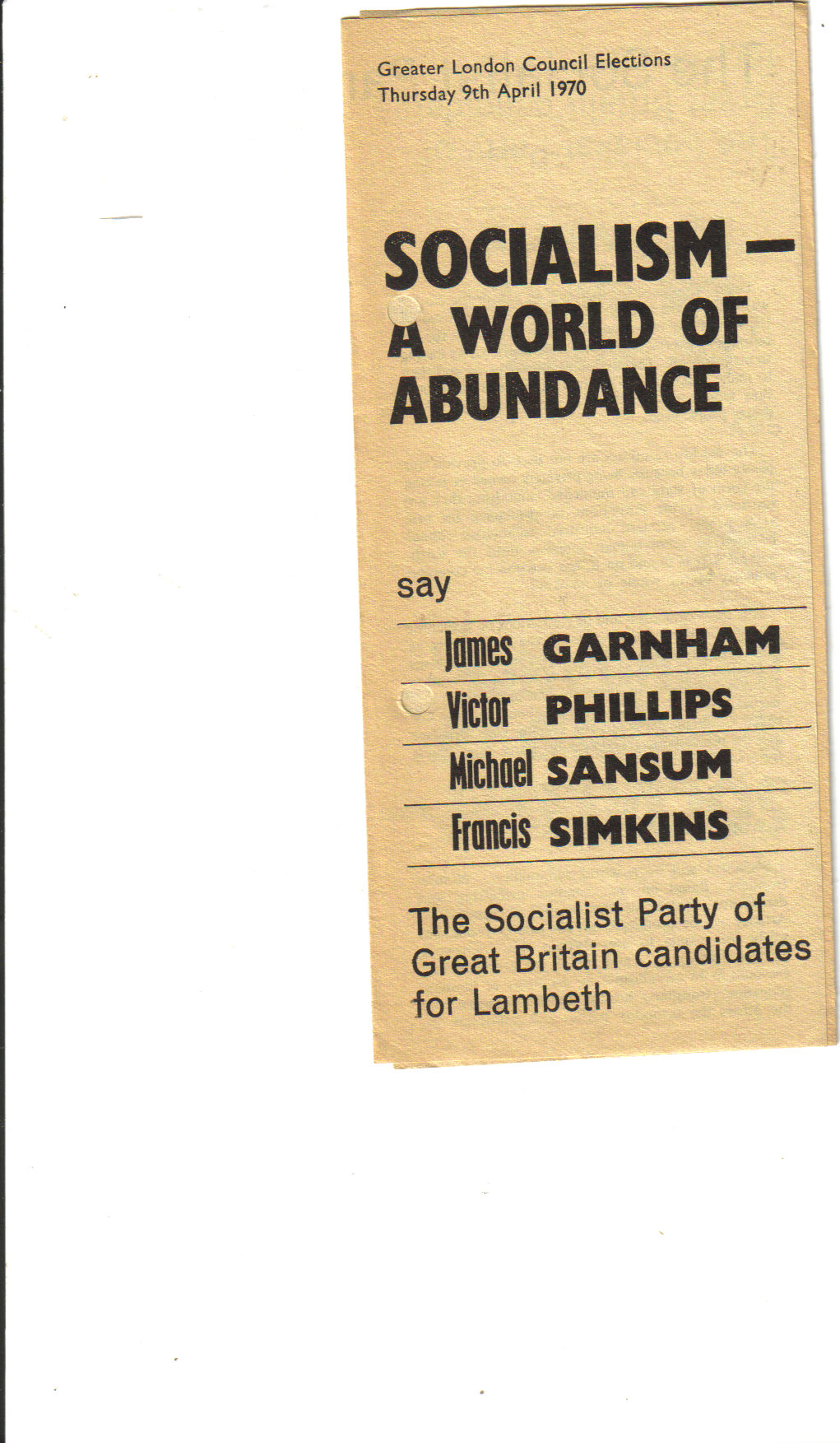
We've stood in this area before, back in the days of the GLC:
Streatham in 1973 the result was:
Geddes (Con) 10492
Walker (Lab) 9426
Mitchell (Lib) 2114
Simpkins (Soc) 120
Boaks (Ind) 57
So we beat Commander Boaks.
In 1970 in Lambeth (3 members) we beat the Union Movement candidate
In 1967 in Lambeth one of our candidates beat one of the CP's, securing the highest number of votes ever won by a Socialist candidate in Britain: 1362. Nice if we could make 4 figures this time.
So, people in Streatham over 50 have had a chance to vote socialist before.


Streatham in 1973 the result was:
Geddes (Con) 10492
Walker (Lab) 9426
Mitchell (Lib) 2114
Simpkins (Soc) 120
Boaks (Ind) 57
So we beat Commander Boaks.
In 1970 in Lambeth (3 members) we beat the Union Movement candidate
In 1967 in Lambeth one of our candidates beat one of the CP's, securing the highest number of votes ever won by a Socialist candidate in Britain: 1362. Nice if we could make 4 figures this time.
So, people in Streatham over 50 have had a chance to vote socialist before.
Subscribe to:
Posts (Atom)